What Is a Gene? Definition, Function, DNA, Chromosomes, Alleles and Gene Pools Explained
What is a gene? Learn how genes work, how they relate to DNA and chromosomes, what different forms of a gene are called, and how gene pools influence inheritance.
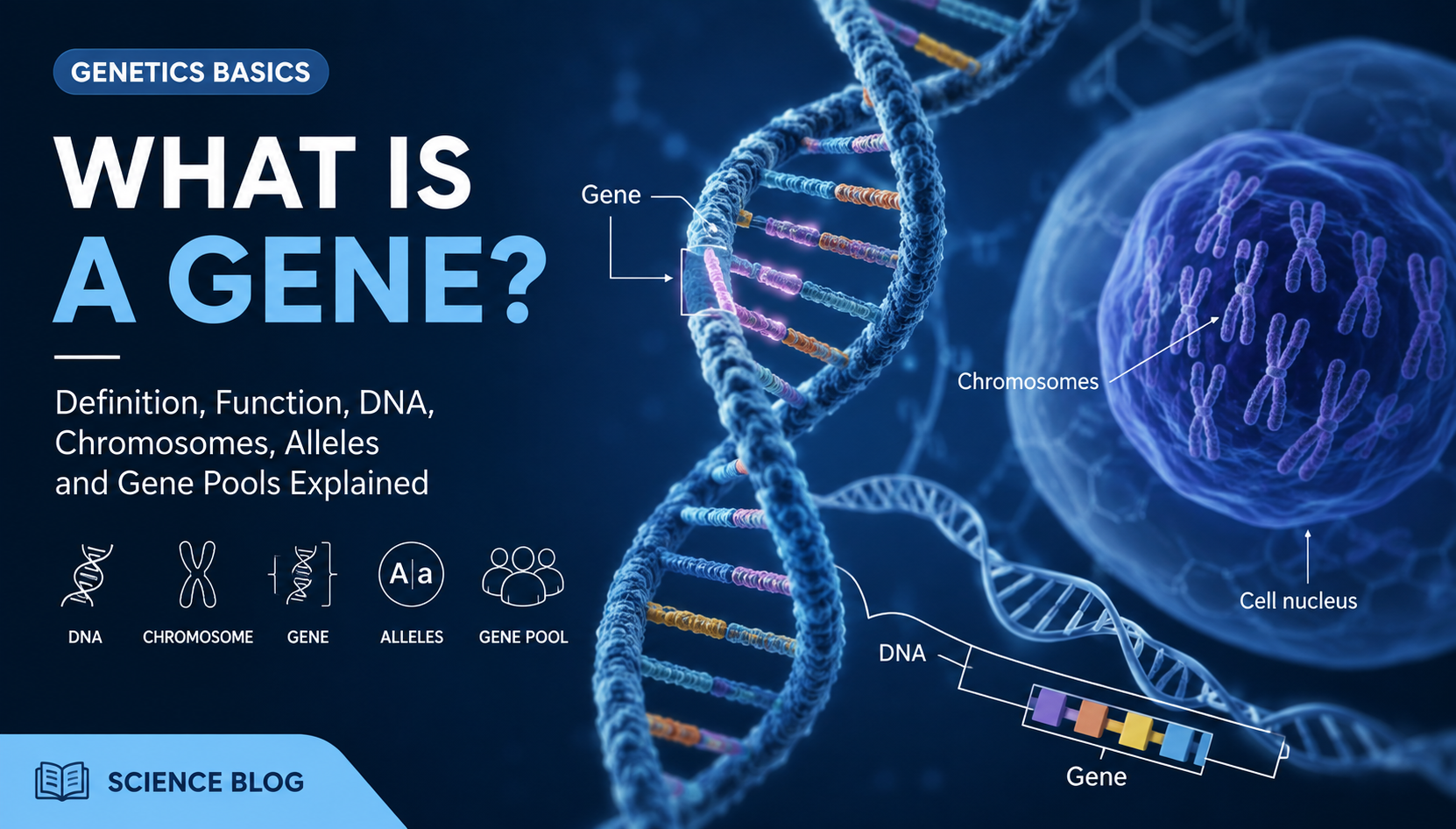
What Is a Gene?

What Is DNA?
DNA, or deoxyribonucleic acid, is the molecule that stores hereditary information in most living organisms.
DNA consists of two complementary strands arranged into a double helix. Its genetic information is encoded through four nucleotide bases:
A - Adenine
T - Thymine
C - Cytosine
G - Guanine
The order of these bases forms the DNA sequence.
Genes are specific functional regions within DNA. Therefore, DNA and genes are not synonymous: DNA is the genetic material, while a gene is a defined DNA sequence with a biological function.

What Is the Difference Between DNA, a Gene and a Chromosome?
| Term | Definition |
|---|---|
| Item one | Description |
| DNA | The molecule that stores genetic information. |
| Gene | A functional DNA sequence that contributes to the production of a functional RNA or protein product. |
| Chromosome | A highly organized DNA–protein structure containing many genes and other DNA sequences. |
| Genome | The complete genetic material of an organism. |
| Allele | An alternative form or sequence variant of a gene at a particular locus. |
A useful hierarchy is :
Cell → Nucleus → Chromosomes → DNA → Genes
However, this simplified model has exceptions. For example, mitochondria contain their own DNA and genes outside the nucleus.
What Are Amino Acids and How Are They Related to Genes?

What Name Is Given to Different Forms of a Gene?
Different forms of a gene are commonly called alleles.
An allele is an alternative sequence form of a gene at a particular genetic locus.
For example, individuals can inherit different alleles from their biological parents. The combination of alleles an individual carries contributes to the individual's genotype, while observable characteristics arising from genotype together with environmental and developmental influences form the phenotype.
This distinction is fundamental to genetics:
Gene: a functional hereditary DNA sequence.
Allele: an alternative form or sequence variant of that gene.
What Is a Gene Pool?
A gene pool is the total collection of genetic variants, including alleles, present in a population at a particular time.
Gene pools are central to population genetics and evolutionary biology.
Allele frequencies within a gene pool can change over generations through mechanisms including:
mutation
natural selection
genetic drift
migration and gene flow
non-random mating
Studying gene pools helps researchers understand genetic diversity, population structure and evolutionary change.

What Is a Gene? A-Level Biology Explanation

Where Are Genes Located?

How Many Genes Do Humans Have?
Humans have roughly 20,000 protein-coding genes, although the exact number depends partly on genome annotation methods and how genes are classified.
The number of genes is much smaller than early estimates made before completion and refinement of the human genome sequence.
Biological complexity therefore does not simply depend on the number of genes. Alternative RNA splicing, gene regulation, non-coding RNAs, protein modification and interactions among genes and regulatory sequences greatly expand biological diversity.
What Is Gene Expression?
Gene expression is the process through which information encoded by a gene produces a functional product.
Cells do not use every gene at the same level or at the same time.
Different patterns of gene expression help explain why cells containing essentially the same genome can perform very different functions.
For example, a neuron and a muscle cell contain largely the same nuclear DNA, but they express different combinations of genes.
Gene expression can be regulated at numerous stages, including transcription, RNA processing, RNA stability, translation and protein modification.
What Is a Genetic Mutation?
A mutation is a change in a DNA sequence.
Mutations can involve a single nucleotide or larger regions of DNA. Examples include substitutions, insertions, deletions, duplications and larger structural alterations.
Their biological effects vary considerably. A mutation can be:
neutral, producing little or no detectable functional effect,
harmful, disrupting biological function or contributing to disease,
or, in some contexts, beneficial, increasing reproductive fitness under particular environmental conditions.
Mutations also provide an important source of new genetic variation upon which evolutionary processes can act.

| Questions | Answers |
|---|---|
| How Can Genes Be Related to Genetic Disease? | Genetic disorders can occur when pathogenic variants alter the function or regulation of genes. For example, cystic fibrosis is associated with pathogenic variants in the CFTR gene. These variants can disrupt the function of the CFTR chloride channel and affect epithelial ion and water transport. However, the relationship between genes and disease is not always simple. Some disorders are primarily associated with variants in a single gene, whereas common conditions can involve many genetic variants together with environmental, developmental and lifestyle factors. Therefore, possessing a particular genetic variant does not always mean that a person will inevitably develop a disease. |
| Genes and Blood Types | Human blood groups provide a classic example of genetic inheritance. The ABO blood group system is strongly influenced by different alleles of the ABO gene. The major A, B and O allele classes contribute to the familiar A, B, AB and O blood-group phenotypes. The ABO system also illustrates concepts such as multiple alleles and codominance. The A and B alleles are codominant with one another, while many common O alleles produce a nonfunctional or substantially altered glycosyltransferase. |
| Are All Genes Active in Every Cell? | No. Most cells contain essentially the same nuclear genome, but different cell types activate and repress different sets of genes. This differential gene expression is essential for cellular specialization. A red-blood-cell precursor, neuron, hepatocyte and muscle cell follow different gene-expression programs despite originating from cells containing essentially the same genome. Mature human red blood cells are a notable exception because they lose their nucleus during development and consequently lack nuclear DNA. |
Gene vs Allele: What Is the Difference?

Frequently Asked Questions About Genes
What is a gene in simple terms?+
A gene is a section of DNA containing information that contributes to making a functional biological product, usually a protein or functional RNA.
What is a gene made of?+
What is a gene made of?
What name is given to different forms of a gene?+
Different forms of a gene are called alleles.
What is a gene pool?+
A gene pool is the total collection of genetic variants present within a population.
Is a gene the same as DNA?+
No. DNA is the molecule that stores genetic information. A gene is a functional sequence within DNA.
Is a chromosome a gene?+
No. A chromosome is a DNA-protein structure containing many genes as well as regulatory and other DNA sequences.
Do genes make proteins?+
Many genes contain instructions for protein production, but not all genes are protein-coding. Some produce functional RNA molecules.
What determines which genes are active?+
Gene activity is controlled by regulatory DNA sequences, transcription factors, chromatin organization, epigenetic mechanisms, RNA regulation and signals within and outside the cell.
Can genes change?+
DNA sequences can change through mutation. Genetic variation can also arise through recombination and other genomic processes.
How many genes are in the human genome?+
Current genome annotations identify approximately 20,000 protein-coding genes, in addition to numerous genes producing non-coding RNAs.