Treating Inherited Diseases with Gene Editing: Progress and Safety
Discover how gene editing technologies such as CRISPR, base editing, and prime editing are advancing the treatment of inherited diseases. Learn about clinical progress, safety challenges, ethical considerations, and the future of precision genetic medicine.

Can Gene Editing Safely Treat Inherited Diseases?
Gene editing is rapidly moving from a research promise to a real therapeutic strategy for some inherited diseases, especially certain blood disorders. The key question is no longer only whether it can work, but whether it can be done safely, precisely, and at scale.
Inherited diseases are caused by harmful changes in DNA that are passed from one generation to the next. Because gene editing can directly correct, disable, or rewrite these disease-causing sequences, it offers a fundamentally different approach from symptom-based treatment. Recent reviews in major journals describe gene editing as one of the most promising routes toward durable treatment or even cure for selected genetic disorders
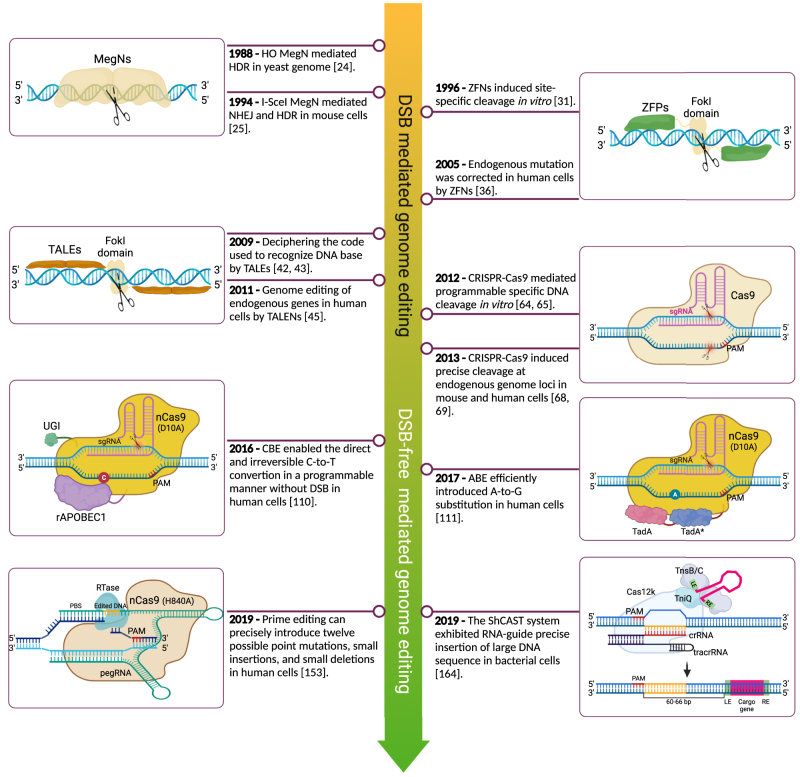
How gene editing works
Gene editing uses engineered molecular tools to target specific DNA sequences in a cell. CRISPR-Cas systems are the most widely known, but newer tools such as base editing and prime editing can make more precise changes with fewer double-strand DNA cuts. This matters because safer tools can reduce unintended mutations, improve control over the edit, and expand the number of diseases that might be treatable.
There are two major treatment models. In ex vivo editing, cells are removed from the patient, edited in the lab, then returned to the body; this approach is especially advanced for blood stem cells. In in vivo editing, the editing system is delivered directly into the body, which is more convenient but technically harder because delivery and tissue targeting are more challenging.
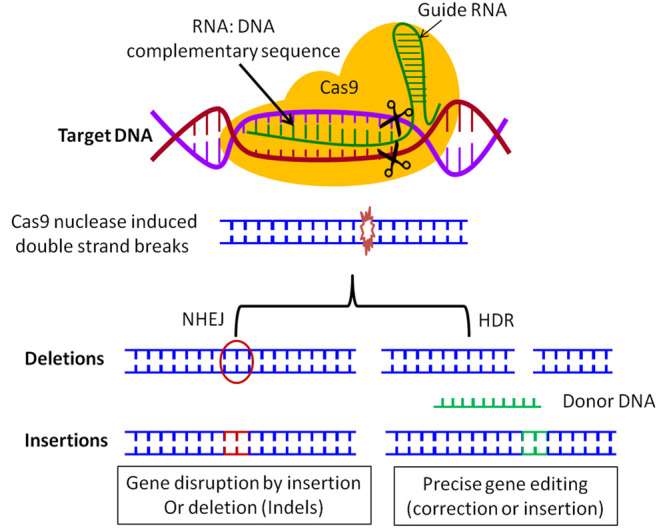
CRISPR mechanism
Guide RNA binds to the target DNA sequence and directs the Cas9 nuclease to induce a double-strand break. The DNA damage is then repaired through either homology-directed repair (HDR) or non-homologous end joining (NHEJ), resulting in targeted genetic modifications such as DNA insertions, deletions, or sequence replacement with specific markers for further analysis.
Where it is already helping
The most important clinical progress so far has been in inherited blood disorders, especially sickle cell disease and transfusion-dependent beta-thalassemia.
In 2023, Casgevy became the first CRISPR-based therapy approved in the UK and later in the US for these conditions, marking a historic move from experimental research to real treatment.
The therapy works by editing a patient’s blood stem cells to restore fetal hemoglobin production, which helps prevent red blood cells from sickling and reduces the severity of disease. »
Clinical results have been especially encouraging for patients who previously had limited options.
Reports from the approval process and review articles show that many treated patients experienced major reductions in painful crises or transfusion dependence, suggesting that gene editing can deliver durable benefits in carefully selected cases.
Beyond blood disorders, gene-editing research is also advancing in retinal diseases and other inherited conditions, but most of those applications are still in earlier stages of development.
Safety concerns
Safety is the central issue limiting broader use. Major reviews emphasize risks such as off-target editing, inefficient delivery, unwanted DNA damage, genomic rearrangements, and immune responses to the editing machinery. These risks are especially important when the target tissue is hard to reach or when the edit must be performed directly inside the body.pubmed.ncbi.nlm.nih+2
Immunogenicity is another concern because the body may react to bacterial-derived proteins like Cas9 or to viral delivery systems. In addition, even highly precise editors can still produce mosaicism or incomplete editing, and that can reduce efficacy or complicate safety interpretation. For inherited diseases, this means that “works in principle” is not enough; the technology must also meet a high standard of reproducibility and long-term monitoring.
| Disease | Gene editing results | Article |
|---|---|---|
| Sickle cell disease | Casgevy became the first CRISPR-based therapy approved in the US and UK; in clinical studies, many treated patients had major reductions in severe pain episodes | U.S. Food and Drug Administration. 2023. FDA Approves First Gene Therapies to Treat Patients with Sickle Cell Disease |
| Transfusion-dependent beta-thalassemia | Casgevy was also authorized for transfusion-dependent beta-thalassemia, and treated patients showed major reductions in transfusion needs | Song X, et al. 2024. Gene therapy and gene editing strategies in inherited blood disorders. |
| Inherited retinal diseases | Gene-editing approaches are being tested for inherited retinal disorders, with the eye considered a strong target because it is accessible and localized | Aaberg TM, et al. 2021. Toward the Treatment of Inherited Diseases of the Retina Using CRISPR-Based Gene Editing. |
| Familial hypercholesterolemia | Gene-editing research is exploring ways to lower disease-causing cholesterol-related genes, but this is still mainly in early development | Precise genome-editing in human diseases: mechanisms, strategies and applications. 2024. |
| Inherited blood disorders in general | Gene editing has produced the most advanced clinical results here, especially for hemoglobin disorders, because blood stem cells can be edited outside the body | Nature Reviews Genetics. 2025. CRISPR-based therapeutic genome editing for inherited blood disorders. |
The Promise and Limits of Gene Editing in Inherited Diseases
Why precision matters+
Older CRISPR approaches often rely on cutting both strands of DNA, which can be effective but may create more unwanted damage. Newer technologies such as base editing and prime editing aim to improve precision by changing individual bases or making small, defined edits without the same level of DNA breakage. Nature reviews describe these as important next-generation tools for inherited blood disorders and broader genetic medicine. However, precision does not automatically mean safety. Even highly targeted systems still need careful validation for off-target effects, tissue specificity, durability, and immune tolerance. That is why many experts describe current gene editing as promising, but still an evolving platform rather than a universal cure
Ethical boundaries+
A major distinction in the field is between somatic and germline editing. Somatic editing changes cells in one patient and is not inherited, while germline editing affects embryos or reproductive cells and can be passed to future generations. Current reviews consistently support somatic editing as the near-term clinical path, while germline editing remains ethically controversial and scientifically risky. This distinction matters because treating a child or adult with a severe genetic disease raises different ethical issues than altering an embryo. In practice, most scientific and regulatory attention is focused on therapies that can help current patients without changing the human germline. That is also where the strongest evidence for benefit already exists.
Future Outlook+
The short answer is that gene editing can safely treat some inherited diseases today, but only in carefully selected settings and with strong controls. The field is advancing quickly, and reviews from Nature, PubMed, ScienceDirect, and Frontiers all point to expanding possibilities as delivery improves, editing tools become more precise, and safety monitoring becomes more sophisticated. For now, the most realistic future is not a single cure for all inherited diseases, but a growing toolkit of gene-editing therapies matched to specific diseases, tissues, and risk profiles. In that sense, gene editing is already reshaping genetic medicine but safely and widely treating inherited disease will depend on continued scientific rigor, ethical restraint, and long-term clinical evidence.
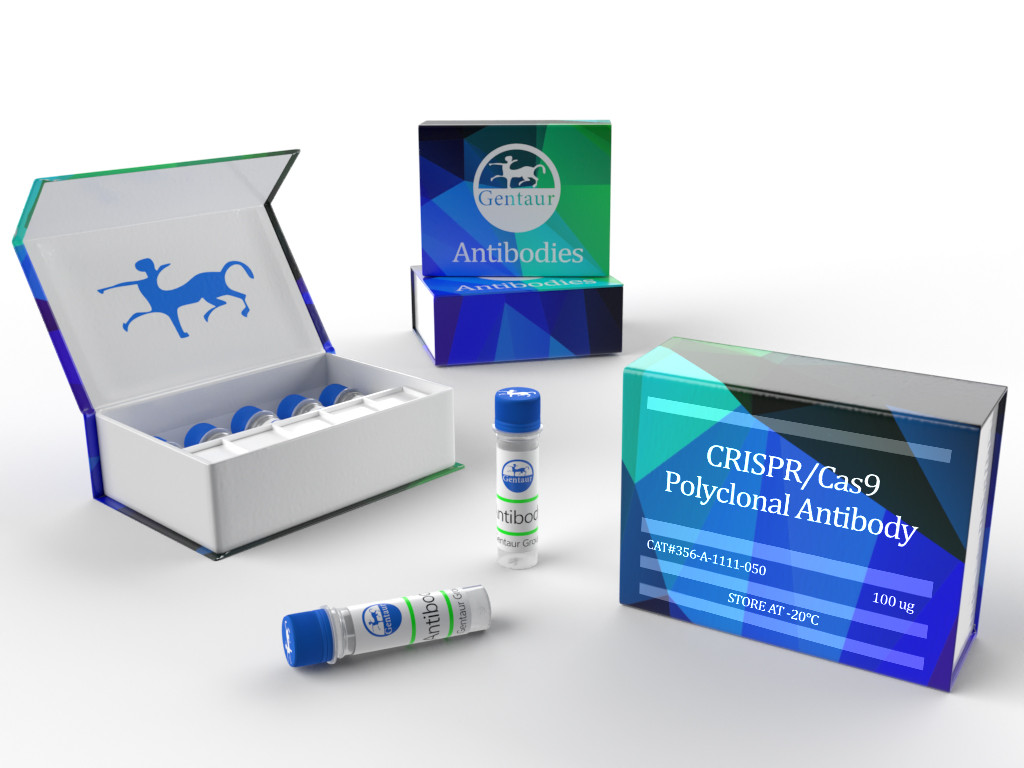
Gene editing research relies on high-quality laboratory tools to design, test, and validate new therapies.
In this field, Gentaur supplies a wide range of products used in molecular biology and genetic research
CRISPR/Cas9 tools
PCR kits
Antibodies
Recombinant proteins
Vectors
Other reagents used in molecular biology and genetic research.
Discover some of our molecular products
CRISPR-Cas9
CRISPR-Cas9
CRISPR-Cas9
Conclusion
Gene editing is no longer just a future idea; it is already changing the treatment of some inherited diseases, especially certain blood disorders. At the same time, its wider use depends on solving major questions about precision, safety, delivery, and ethics. In the near future, gene editing is likely to remain a powerful but carefully controlled medical tool rather than a universal cure for all genetic diseases.