The Cell Cycle Explained: Stages, Regulation, and Why It Matters in Cell Biology
Every living organism depends on the ability of cells to grow, duplicate their genetic material, and divide accurately. This carefully controlled process is known as the cell cycle. Whether scientists are studying tissue development, stem cells, genetics, molecular biology, biotechnology, or cell culture, understanding the cell cycle is fundamental. The cell cycle is not simply a sequence of events leading to cell division. It is a highly regulated biological program that ensures every daughter cell receives an identical copy of the genome while maintaining cellular integrity. This guide explains each stage of the cell cycle, the molecular mechanisms controlling progression, major checkpoints, regulatory proteins, and modern laboratory techniques used to study cell cycle dynamics.
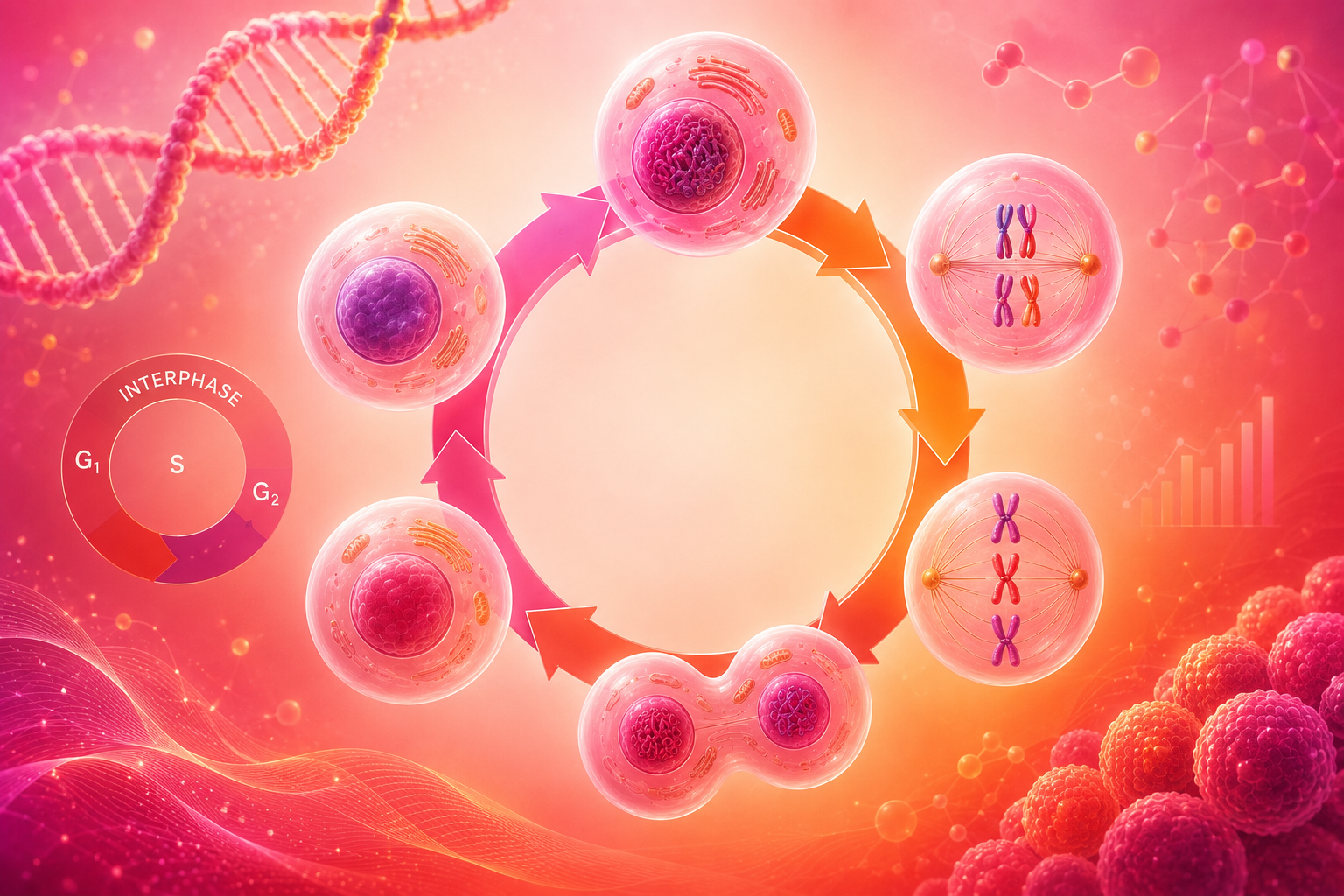
What Is the Cell Cycle?

Interphase occupies approximately 90% of the total cell cycle, while mitosis represents the shorter but highly dynamic division stage.
Overview of Cell Cycle Phases
The cell cycle is divided into four principal phases:
G1 Phase (Gap 1)
S Phase (DNA Synthesis)
G2 Phase (Gap 2)
M Phase (Mitosis and Cytokinesis)
Between active cycles, some cells may enter a resting state known as G0 Phase.
Cell Cycle in Research Laboratories
Cell cycle analysis is essential in numerous research disciplines.
Applications include:
Cell biology
Molecular biology
Developmental biology
Genetics
Stem cell research
Biotechnology
Toxicology
Regenerative biology
Drug discovery research
Functional genomics
Researchers monitor cell cycle progression to understand cellular responses under different experimental conditions.

Frequently asked questions
What are the four phases of the cell cycle?+
The four main phases are G1, S, G2, and M, together forming the complete cell cycle.
Which phase takes the longest?+
Interphase occupies approximately 90% of the total cell cycle, with G1 often being the longest stage in many cell types.
What happens during the S phase?+
DNA replication occurs, producing identical copies of every chromosome before mitosis.
Why are cell cycle checkpoints important?+
Checkpoints verify DNA integrity, successful replication, proper chromosome alignment, and overall readiness before allowing progression to the next stage.
Which laboratory technique is commonly used for cell cycle analysis?+
Flow cytometry is one of the most widely used methods for measuring DNA content and determining the distribution of cells across different cell cycle phases.
Conclusion
The cell cycle is one of the most fundamental processes in cellular biology, coordinating growth, DNA replication, chromosome segregation, and cell division with remarkable precision. From the G1 checkpoint to cytokinesis, every stage is tightly regulated by cyclins, cyclin-dependent kinases, and checkpoint mechanisms that preserve genomic stability. Understanding these processes is essential for researchers working in molecular biology, genetics, biotechnology, developmental biology, stem cell science, and cell culture. Combined with modern analytical techniques such as flow cytometry, fluorescence microscopy, immunofluorescence, and molecular assays, comprehensive cell cycle analysis continues to advance discoveries across life science research.