Single-Cell Sequencing Explained: A Complete Guide to Technologies, Workflow and Applications
Modern sequencing technologies have transformed biological research by making it possible to investigate individual cells instead of analyzing entire populations. Single-Cell Sequencing (SCS) enables researchers to examine the genetic and molecular characteristics of each cell independently, revealing cellular diversity that traditional bulk sequencing often masks. Today, single-cell sequencing has become one of the fastest-growing technologies in genomics, transcriptomics, developmental biology, neuroscience, immunology, agricultural sciences, and biotechnology. It helps researchers understand complex biological systems, identify rare cell populations, and explore cellular functions with unprecedented resolution. This guide explains everything you need to know about single-cell sequencing, including its principles, workflow, technologies, applications, advantages, challenges, and future developments.
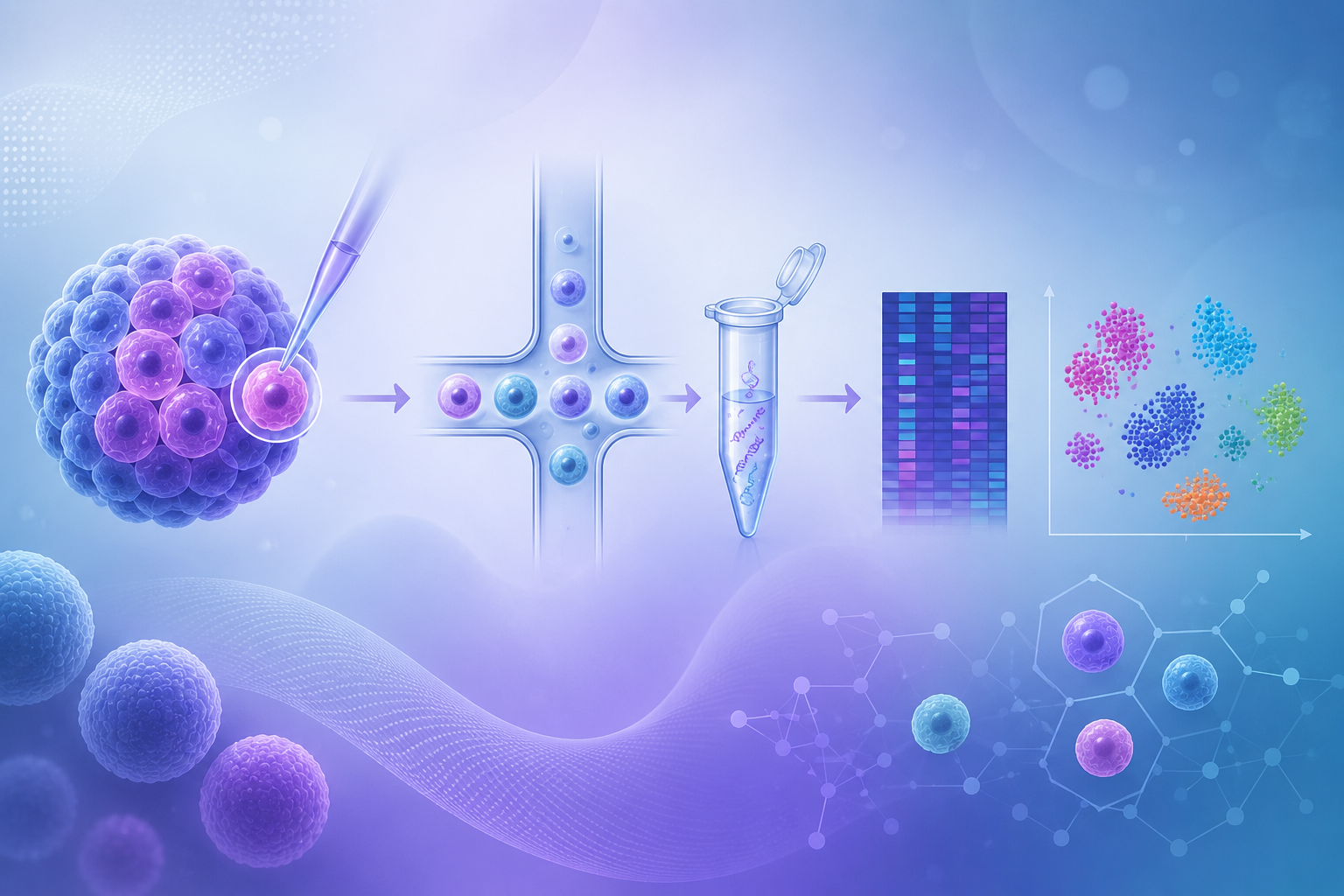
What Is Single-Cell Sequencing?

Why Is Single-Cell Sequencing Important?
Related products
Single Cell WGA Kit
Single Cell WGA Kit
Cell Holder, Single Cell
Single Cell RT-PCR Assay Kit
Single Cell Lysis Module
Discover-sc Single Cell Kit
Discover-sc Single Cell Kit
ABcellar Single Cell Chip Set
ABcellar Single Cell Chip Set
6 x Single Cell Locker Copper
6 x Single Cell Locker St steel
Discover-sc Single Cell WGA Kit
Discover-sc Single Cell WGA Kit
Discover-sc Single Cell WGA Kit
Stackable Cell Holder, Single Cell
Major Single-Cell Sequencing Technologies
Several commercial and academic platforms are widely used.
Droplet-Based Platforms
Advantages include:
High throughput
Cost efficiency
Thousands of cells per experiment
Fast processing
Plate-Based Methods
Benefits include:
Higher transcript coverage
Greater sequencing depth
Improved sensitivity
Excellent for detailed cellular studies
Microwell Technologies
Microwell systems provide:
Moderate throughput
Flexible experimental design
Lower equipment requirements
Combinatorial Indexing
This technology labels cells through multiple rounds of indexing instead of physical isolation.
Advantages include:
Massive scalability
Reduced processing costs
Millions of cells in large studies

Advantages of Single-Cell Sequencing

Single-Cell Sequencing vs Bulk Sequencing
Feature | Single-Cell Sequencing | Bulk Sequencing |
|---|---|---|
Resolution | Individual cells | Entire population |
Rare Cell Detection | Excellent | Limited |
Cellular Diversity | High | Averaged |
Data Complexity | Very High | Moderate |
Cost | Higher | Lower |
Computational Analysis | Advanced | Standard |
Conclusion
Single-cell sequencing has transformed modern biological research by enabling scientists to analyze individual cells with extraordinary precision. From gene expression profiling and genome analysis to multiomics integration and spatial biology, this technology provides valuable insights into cellular diversity and molecular organization. As sequencing platforms become faster, more affordable, and increasingly automated, single-cell sequencing will continue to play a central role in genomics, biotechnology, systems biology, agricultural research, and precision molecular science. Researchers now have unprecedented opportunities to explore complex biological systems one cell at a time.
Frequently asked questions
What is single-cell sequencing?+
Single-cell sequencing is a molecular technique that analyzes DNA, RNA, or other biomolecules from individual cells to reveal cellular diversity and molecular differences.
What is scRNA-seq?+
Single-cell RNA sequencing (scRNA-seq) measures gene expression in individual cells by sequencing messenger RNA (mRNA), enabling detailed transcriptomic profiling.
What is the main advantage of single-cell sequencing?+
Its primary advantage is the ability to study each cell independently, allowing researchers to identify rare cell populations, characterize cellular diversity, and understand complex biological systems with high resolution.
How is single-cell sequencing different from bulk sequencing?+
Bulk sequencing averages molecular signals across many cells, while single-cell sequencing generates separate profiles for each individual cell, revealing differences that bulk methods can overlook.
What are the major applications of single-cell sequencing?+
Applications include developmental biology, neuroscience, immunology, plant biotechnology, microbiology, regenerative biology, cell atlas projects, and multiomics research.