PCR Troubleshooting Guide: Common PCR Problems, Causes and Solutions
PCR troubleshooting guide covering no amplification, weak bands, multiple bands, PCR smearing, primer dimers, contamination, primer design and optimization.
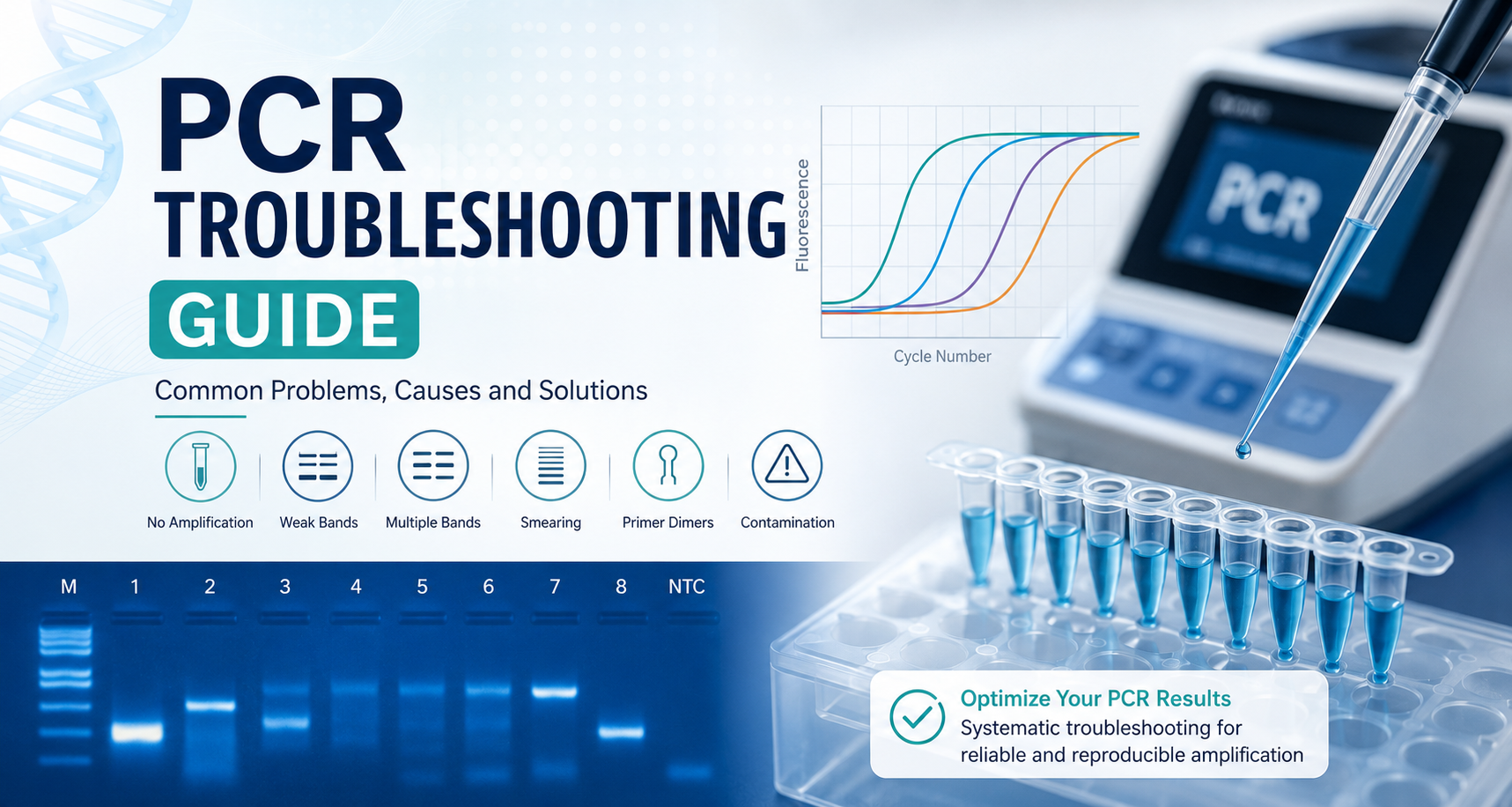
Quick PCR Troubleshooting Table
| PCR problem | Common causes | Recommended troubleshooting |
|---|---|---|
| No PCR product / no band | Poor template quality, inhibitors, incorrect cycling conditions, primer problems, inactive polymerase | Verify template and controls, confirm reaction setup, check primer sequences, optimize annealing temperature |
| Weak or faint PCR band | Low template concentration, inefficient primers, suboptimal annealing, insufficient amplification | Check template quality and quantity, optimize annealing conditions and cycle number |
| Multiple PCR bands | Nonspecific primer binding, low annealing temperature, excessive primer/template | Increase stringency, optimize annealing temperature, review primer specificity |
| PCR smear | Excess template, too many cycles, nonspecific amplification, degraded DNA, suboptimal reaction conditions | Reduce template/cycle number, optimize annealing and reaction components |
| Primer dimers | Primer complementarity, especially at 3′ ends, excessive primer concentration | Redesign primers or optimize primer concentration and annealing conditions |
| Unexpected band size | Nonspecific amplification, incorrect primer design, contamination, genomic DNA | Verify primer sequences and expected amplicon, include controls, confirm product identity |
| Amplification in negative control | Carryover or reagent contamination, primer-dimer formation | Replace reagents, clean work area, use fresh aliquots and appropriate negative controls |
| Variable results between replicates | Pipetting variation, inconsistent template, poor mixing, evaporation | Use master mixes, calibrated pipettes, consistent sample preparation and proper sealing |
What Should You Check First When PCR Fails?
Before extensively changing the PCR protocol, check the basic experimental variables.
1. Verify the PCR reaction setup
2. Examine the controls
3. Check the DNA template


What Should You Check First When PCR Fails?

PCR Smearing on an Agarose Gel
What causes PCR smearing?
A PCR smear rather than a discrete band usually indicates heterogeneous amplification products or problems with the template or reaction conditions.
Common causes include:
Too much DNA template
Excessive PCR cycle number
Low annealing stringency
Excessive primer concentration
Suboptimal Mg²⁺ concentration
Degraded template DNA
Poor primer specificity
Excessively long annealing or extension steps

How do you fix PCR smearing?
Start with the variables most likely to affect specificity.
Reduce excessive template input if applicable and optimize the annealing temperature. Review the number of cycles and primer design before making extensive changes to reaction chemistry.
If the starting DNA itself appears degraded on a gel, optimizing the PCR may not fully correct the problem; improving sample preparation may be necessary.
Primer-Dimer Formation

How can primer dimers be reduced?
Consider:
Checking forward and reverse primers for complementarity
Avoiding strong 3′ complementarity
Optimizing primer concentrations
Increasing annealing stringency
Using hot-start PCR chemistry where appropriate
Redesigning problematic primers
Primer design should be reconsidered when optimization repeatedly fails to remove a strong primer-dimer product.
Unexpected PCR Product Size

A PCR product that does not match the predicted amplicon size should not automatically be considered the intended target.
Possible explanations include:
Nonspecific primer binding
Incorrect primer sequence
Incorrect target sequence
Genomic DNA contamination in RT-PCR
Alternative transcript isoforms
Insertions or deletions
Sample contamination
Confirm the expected amplicon coordinates and primer orientation.
When exact product identity matters, sequencing the PCR product provides much stronger evidence than estimating molecular size from an agarose gel.
PCR Amplification in the No-Template Control

PCR Primer Troubleshooting
Primer design is one of the most important determinants of PCR specificity.
When troubleshooting primers, evaluate:
Primer specificity
Use an appropriate sequence-alignment or primer-design tool to determine whether the primers have significant potential off-target binding sites.
Primer melting temperature
Forward and reverse primers should be compatible with the same annealing conditions.
Primer complementarity
Check for:
Self-complementarity
Cross-complementarity
Hairpin formation
3′ complementarity
Amplicon characteristics
Consider the:
Expected product length
GC content
Secondary structure
Repetitive regions
Sequence complexity
If repeated optimization fails, redesigning the primers may be more efficient than continually modifying the PCR conditions.
Annealing Temperature and PCR Specificity

Frequently Asked Questions About PCR Troubleshooting
Why am I getting no amplification in PCR?+
No PCR amplification can result from degraded or insufficient template, PCR inhibitors, incorrect primer design, excessively stringent annealing conditions, missing reaction components, inactive polymerase or an incorrect thermal cycling program. A positive control is one of the fastest ways to determine whether the basic PCR system is functional.
Why am I getting multiple bands in PCR?+
Multiple PCR bands commonly result from nonspecific primer binding. Low annealing stringency, poor primer specificity and inappropriate reaction conditions can contribute. In RT-PCR, however, alternative transcripts can sometimes produce genuine products of different sizes.
Why is my PCR product smeared?+
PCR smearing may be associated with excessive template, too many cycles, degraded DNA, low annealing stringency or suboptimal concentrations of primers and other reaction components.
How can I increase PCR specificity?+
PCR specificity can often be improved by optimizing annealing temperature, reviewing primer design, adjusting template and primer concentrations and using suitable hot-start PCR chemistry. If nonspecific amplification persists, primer redesign may be necessary.
How can I increase PCR yield?+
First determine why the yield is low. Check template quality and concentration, primer efficiency, annealing conditions, polymerase compatibility and reaction setup. Increasing cycle number without identifying the underlying cause can increase nonspecific amplification.
What causes primer dimers?+
Primer dimers occur when primers hybridize to each other and become substrates for polymerase extension. Complementarity at or near the 3′ ends is particularly important. Primer redesign, optimized concentrations and increased annealing stringency can reduce primer-dimer formation.
What is the best annealing temperature for PCR?+
There is no universal optimal annealing temperature. It depends primarily on the primer sequences, their melting temperatures and the reaction chemistry. A gradient PCR is often the most practical experimental method for identifying suitable annealing conditions.
Why does my negative PCR control have a band?+
A band in a no-template control may indicate contamination by DNA or previous PCR products. Small products may also result from primer-dimer formation. Repeating the reaction with fresh reagents and appropriate contamination controls can help distinguish these possibilities.
Should I increase PCR cycles if I have a weak band?+
Not automatically. Additional cycles may increase yield but can also amplify nonspecific products. Template quality, primer performance and reaction conditions should be evaluated first.
How do I know whether my PCR product is correct?+
Expected gel size is useful but does not conclusively establish product identity. Depending on the application, specificity can be assessed using appropriate controls, restriction analysis, melt-curve behavior or sequencing. Sequencing provides direct confirmation of the amplified sequence.
“PCR troubleshooting becomes much easier when the observed result is treated as diagnostic information. No amplification often points toward template, reagent, primer or cycling problems. Multiple bands and smearing usually direct attention toward amplification specificity. Primer dimers suggest primer-interaction problems, while amplification in negative controls requires careful investigation of contamination and primer-derived artifacts. The most reliable approach is systematic: use appropriate controls, verify template and primer quality, optimize amplification conditions methodically and change as few variables as possible at each step. A well-designed troubleshooting strategy does more than rescue a failed PCR. It improves the specificity, reproducibility and scientific reliability of future experiments.”