Lentiviral Vector Systems in Biomedical Research
Explore the principles, design, production, and applications of lentiviral vector systems in biomedical research. Learn how lentiviral vectors enable stable gene delivery for gene therapy, CRISPR genome editing, stem cell engineering, cancer immunotherapy, and translational medicine.

Introduction
Lentiviral vectors (LVs) are among the most widely used gene delivery systems in modern biomedical research. Derived primarily from the Human Immunodeficiency Virus Type 1 (HIV-1), these vectors have been extensively engineered to eliminate pathogenic properties while preserving their exceptional ability to deliver genetic material into dividing and non-dividing cells.
Over the past two decades, lentiviral vectors have become indispensable tools in molecular biology, functional genomics, regenerative medicine, cancer immunotherapy, and gene therapy. Their ability to mediate stable integration into the host genome enables long-term transgene expression, making them particularly valuable for applications requiring persistent genetic modification.
What Are Lentiviral Vectors?
A lentiviral vector is a genetically modified viral delivery platform derived from lentiviruses. Unlike replication-competent viruses, modern lentiviral vectors are replication-defective because the viral genes required for producing infectious particles are removed and supplied only during vector manufacturing.
Once a lentiviral particle enters a target cell, its RNA genome undergoes reverse transcription into complementary DNA (cDNA). This DNA is then transported into the nucleus and integrated into the host genome through the action of the viral integrase enzyme. The integrated transgene becomes a stable part of the cell's genetic material, allowing long-term expression that can persist through multiple cell divisions.
This characteristic distinguishes lentiviral vectors from many transient gene delivery systems.
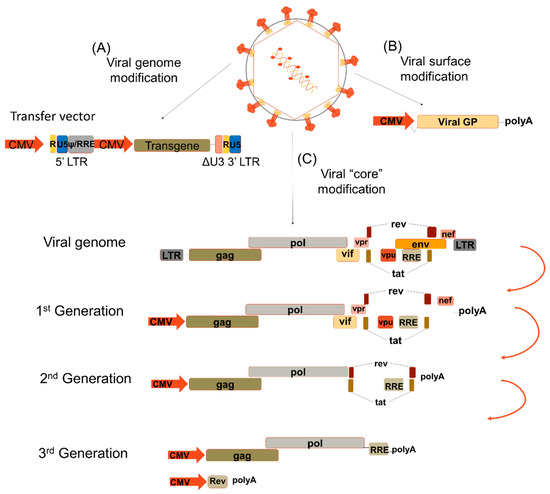
Lentiviral vectors have been engineered over successive generations to improve safety and efficiency. The transfer vector carries the therapeutic gene under a strong promoter, while pseudotyping with different viral glycoproteins enables targeting of specific cell types. Compared with the first generation, second- and third-generation vectors remove or separate viral genes, reducing the risk of replication while maintaining efficient and stable gene delivery.
Evolution of Lentiviral Vector Technology
The development of lentiviral vectors has progressed through several generations designed to improve biosafety while maintaining high transduction efficiency.
First Generation
The earliest systems retained many HIV-derived genes and therefore presented higher biosafety concerns.
Characteristics include:
High transduction efficiency
Limited safety profile
Research use only
Second Generation
Several accessory genes (vif, vpr, vpu, nef) were removed to reduce the likelihood of generating replication-competent viruses.
Advantages:
Improved safety
Reduced viral pathogenicity
Enhanced laboratory handling
Third Generation
Their multi-plasmid design and self-inactivating long terminal repeats reduce the risk of replication while maintaining efficient gene delivery.
Benefits include:
Self-inactivating design and Lower recombination risk
High transduction efficiency
Suitable for preclinical and clinical research
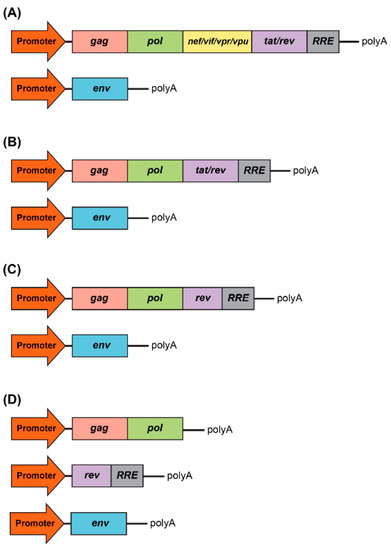
Development of lentiviral packaging systems.
(A) The first-generation system contained all accessory genes (nef, vif, vpr, and vpu) together with the regulatory proteins tat and rev. RRE denotes the Rev response element. (
B) The second-generation system removed the accessory genes while retaining the regulatory proteins.
(C) The third-generation system further improved safety by eliminating the tat regulatory protein.
(D) The fourth-generation system separates the gag/pol and rev sequences into two independent expression cassettes, providing an additional level of biosafety by reducing the risk of recombination.
Structure of a Lentiviral Vector
Modern lentiviral vectors contain only the genetic elements necessary for efficient gene transfer.
| Component | Function |
|---|---|
| 5' LTR | Initiates reverse transcription |
| Packaging signal (Ψ) | Enables RNA packaging into viral particles |
| Rev Response Element (RRE) | Facilitates RNA export |
| Central Polypurine Tract (cPPT) | Enhances nuclear import |
| Promoter | Drives transgene expression |
| Drives transgene expression | Allows insertion of the gene of interest |
| Reporter gene (optional) | GFP, mCherry, luciferase for monitoring expression |
| Woodchuck Hepatitis Virus Post-transcriptional Regulatory Element (WPRE) | Improves mRNA stability and expression |
| 3' Self-Inactivating LTR | Prevents promoter activity after integration |
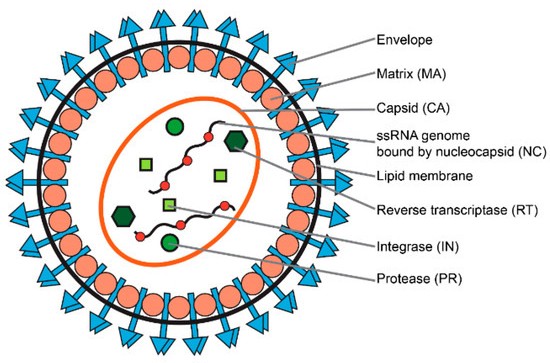
Structure of lentiviral vectors.
Modern lentiviral vectors retain only the essential viral elements for efficient gene delivery. Successive generations of packaging systems have improved biosafety by removing accessory genes, separating viral functions, and incorporating regulatory elements that enhance vector stability and transgene expression.
Lentiviral Vector Production
Lentiviral particles are typically produced using transient transfection of HEK293T cells with multiple plasmids:
Transfer plasmid containing the gene of interest
Packaging plasmid encoding Gag and Pol proteins
Rev plasmid
Envelope plasmid encoding VSV-G glycoprotein
Following transfection, viral particles are assembled, released into the culture medium, harvested, concentrated, and purified before use.
The separation of viral functions across different plasmids minimizes the probability of recombination leading to replication-competent lentiviruses.
Lentiviral vector products provide researchers with powerful tools for stable gene delivery, functional genomics, and cell engineering applications. These solutions include lentiviral expression vectors, shRNA and CRISPR-based systems, reporter vectors, packaging components, and ready-to-use lentiviral particles. They are widely used in gene regulation studies, stem cell research, cancer biology, neuroscience, and the development of advanced cell and gene therapies.
» Gentaur provides access to specialized molecular biology products supporting researchers in their gene delivery and biotechnology workflows.
Related products
LipoVector™ Solution
LipoVector™ Solution
RTS pIVEX E. coli His-tag, 2nd Gen. Vector Set (2 vectors)
PBIVT Vector Set-1 (each 5 ug)
Rac1 Expression Vector Set
RhoA Expression Vector Set
H-Ras Expression Vector Set
Cdc42 Expression Vector Set
Mechanism of Gene Delivery
The lentiviral transduction process involves several sequential steps:
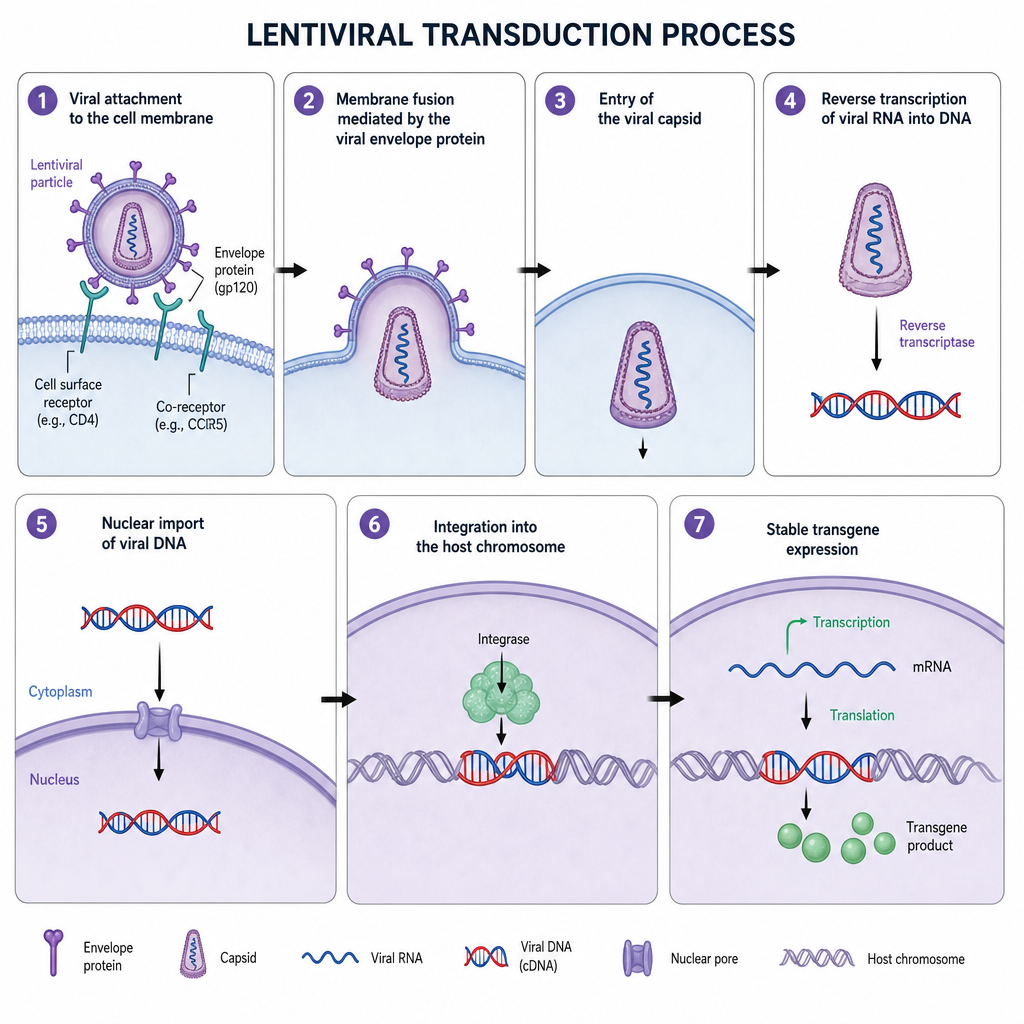
» Unlike many retroviruses, lentiviral vectors can efficiently transduce non-dividing cells because their pre-integration complex is actively transported into the nucleus.
Future Perspectives
Next-generation lentiviral vectors are being engineered to improve targeting specificity, integration profiles, and manufacturing scalability.
Emerging strategies include integrase-deficient lentiviral vectors, cell-specific pseudotyping, synthetic promoter design, and regulated transgene expression systems.
In combination with CRISPR-based genome editing and advanced cell therapies, lentiviral technology is expected to remain a cornerstone of precision medicine and translational biomedical research.
Conclusion
Lentiviral vector systems have transformed biomedical research by providing a reliable platform for stable gene delivery across diverse cell types.
Their versatility has enabled advances in functional genomics, stem cell biology, neuroscience, cancer research, and gene therapy.
Continued innovations in vector engineering and safety are expanding their clinical potential, making lentiviral vectors one of the most powerful tools in modern molecular medicine.