HPLC Explained: Meaning, Machine, Test, Uses and Chromatogram Interpretation
What is HPLC? Learn the meaning of high-performance liquid chromatography, how an HPLC machine works, what an HPLC test measures and how to interpret an HPLC chromatogram.
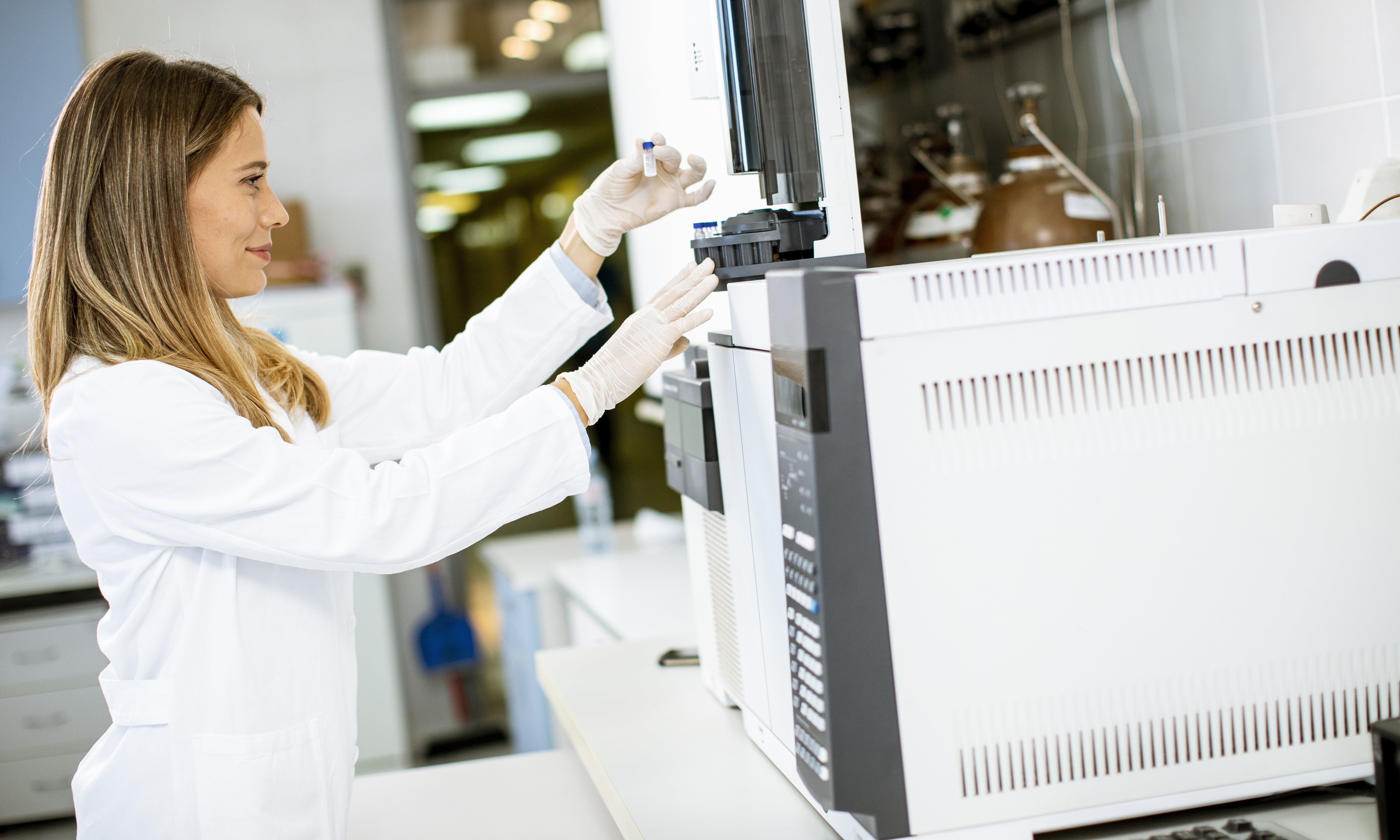
HPLC Explained: Meaning, Machine, Test, Uses and How to Interpret an HPLC Chromatogram
High-performance liquid chromatography, commonly abbreviated as HPLC, is one of the most widely applied analytical separation techniques in pharmaceutical science, biotechnology, chemistry, food analysis, environmental testing and clinical research.
An HPLC test can separate the individual components of a complex sample, help identify those components and determine how much of each compound is present. The technique is especially useful for substances that are non-volatile, thermally unstable or unsuitable for direct analysis by gas chromatography.
This guide explains the meaning of HPLC, how an HPLC machine works, what an HPLC test measures, how the mobile phase and column control separation, and how to interpret an HPLC chromatogram.
What is HPLC?
HPLC stands for high-performance liquid chromatography.
It is a form of liquid chromatography in which a liquid mobile phase transports a sample through a column containing a stationary phase. The compounds in the sample interact differently with these two phases, causing them to travel through the column at different rates and become separated.
IUPAC defines chromatography as a physical separation method in which sample components are distributed between a stationary phase and a mobile phase moving in a defined direction. In liquid chromatography, that moving phase is a liquid.
HPLC meaning in simple terms
HPLC can be understood as a controlled molecular race:
A liquid sample is introduced into the instrument.
A pump moves the sample and solvent through a packed column.
Different compounds interact differently with the column material.
The compounds leave the column at different times.
A detector converts their passage into peaks on a chromatogram.
The resulting data can be used for both qualitative analysis, which investigates what is present, and quantitative analysis, which determines how much is present.

Why is it called high-performance liquid chromatography?
Earlier forms of liquid column chromatography often depended on gravity to move solvent through comparatively large particles. Modern HPLC uses controlled pumping systems, carefully manufactured columns and smaller stationary-phase particles to obtain faster and more efficient separations.
The technique emerged in its modern form during the late 1960s as advances in column-packing materials, pressure-resistant equipment and instrumentation made high-efficiency liquid separations practical. HPLC was historically also called high-pressure liquid chromatography, although “high-performance” better reflects the combined importance of column efficiency, selectivity and instrumentation.
How does HPLC chromatography work?
An HPLC separation depends on the distribution of sample molecules between two phases:
Mobile phase
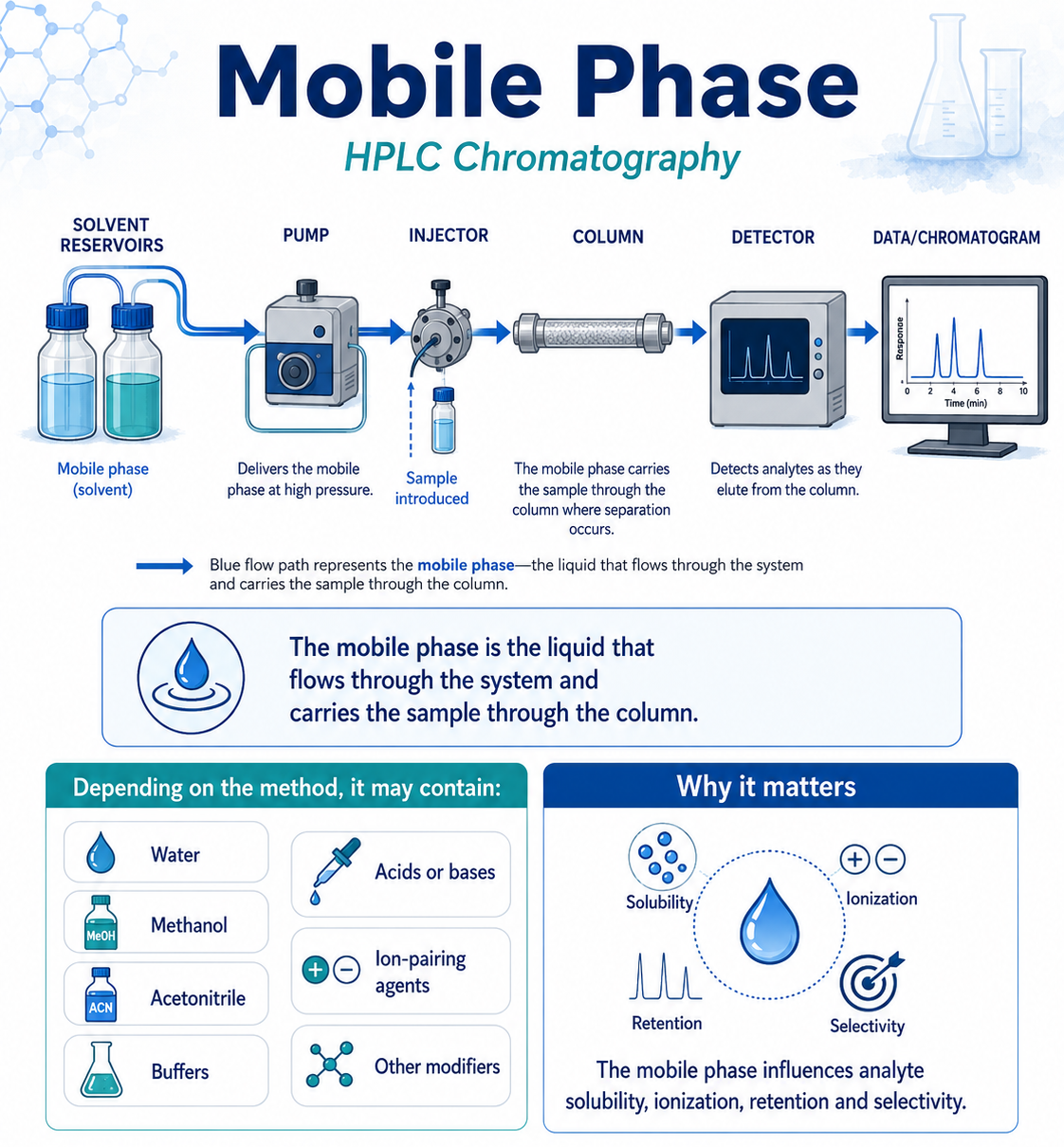
The mobile phase is the liquid that flows through the system and carries the sample through the column.
Depending on the method, it may contain:
Water
Methanol
Acetonitrile
Buffers
Acids or bases
Ion-pairing agents
Other modifiers
The mobile phase influences analyte solubility, ionization, retention and selectivity. IUPAC describes it as the fluid that moves through or along the stationary bed in a defined direction.
Stationary phase
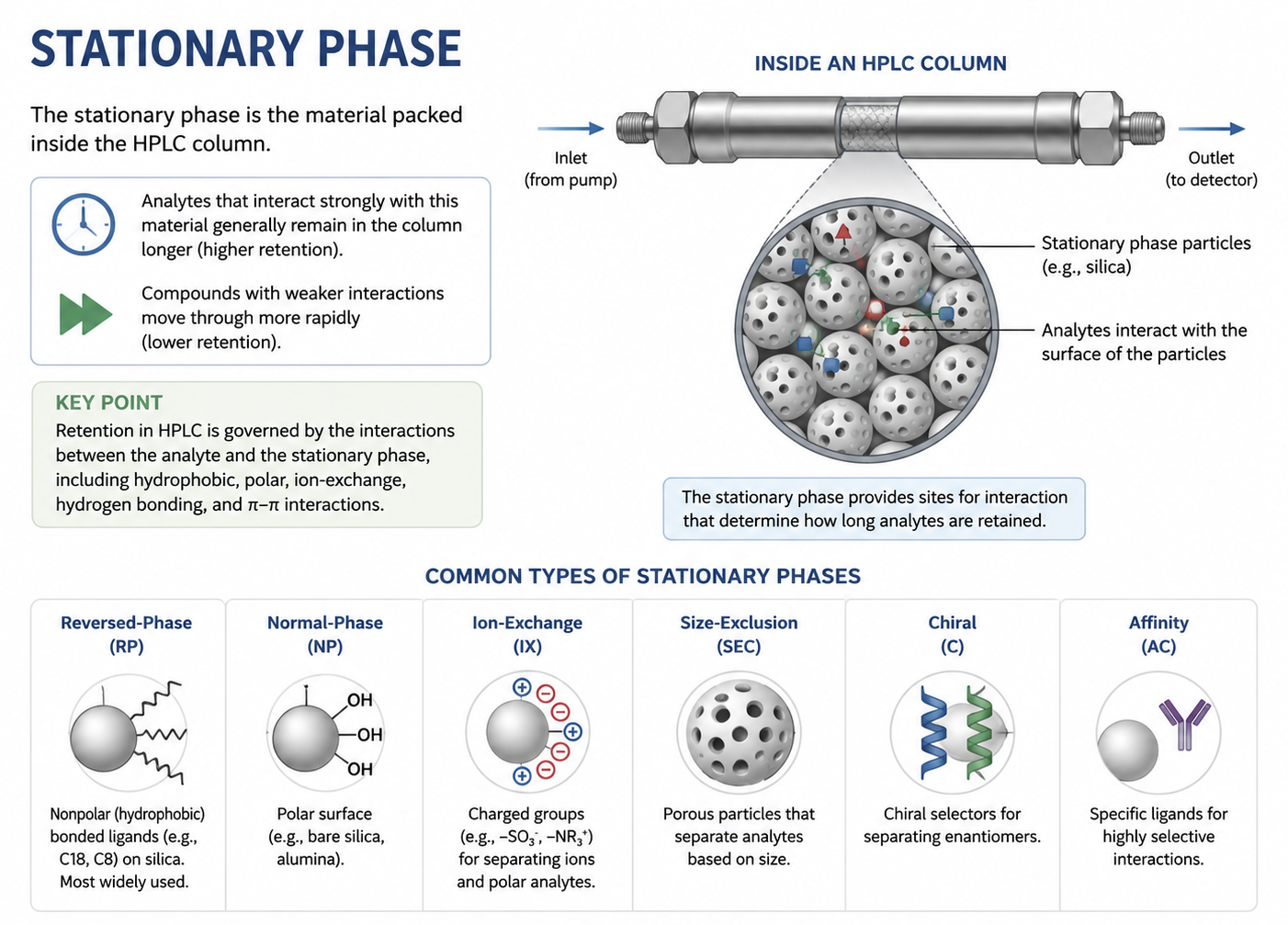
The stationary phase is the material packed inside the HPLC column. Analytes that interact strongly with this material generally remain in the column longer, while compounds with weaker interactions move through more rapidly.
Separation
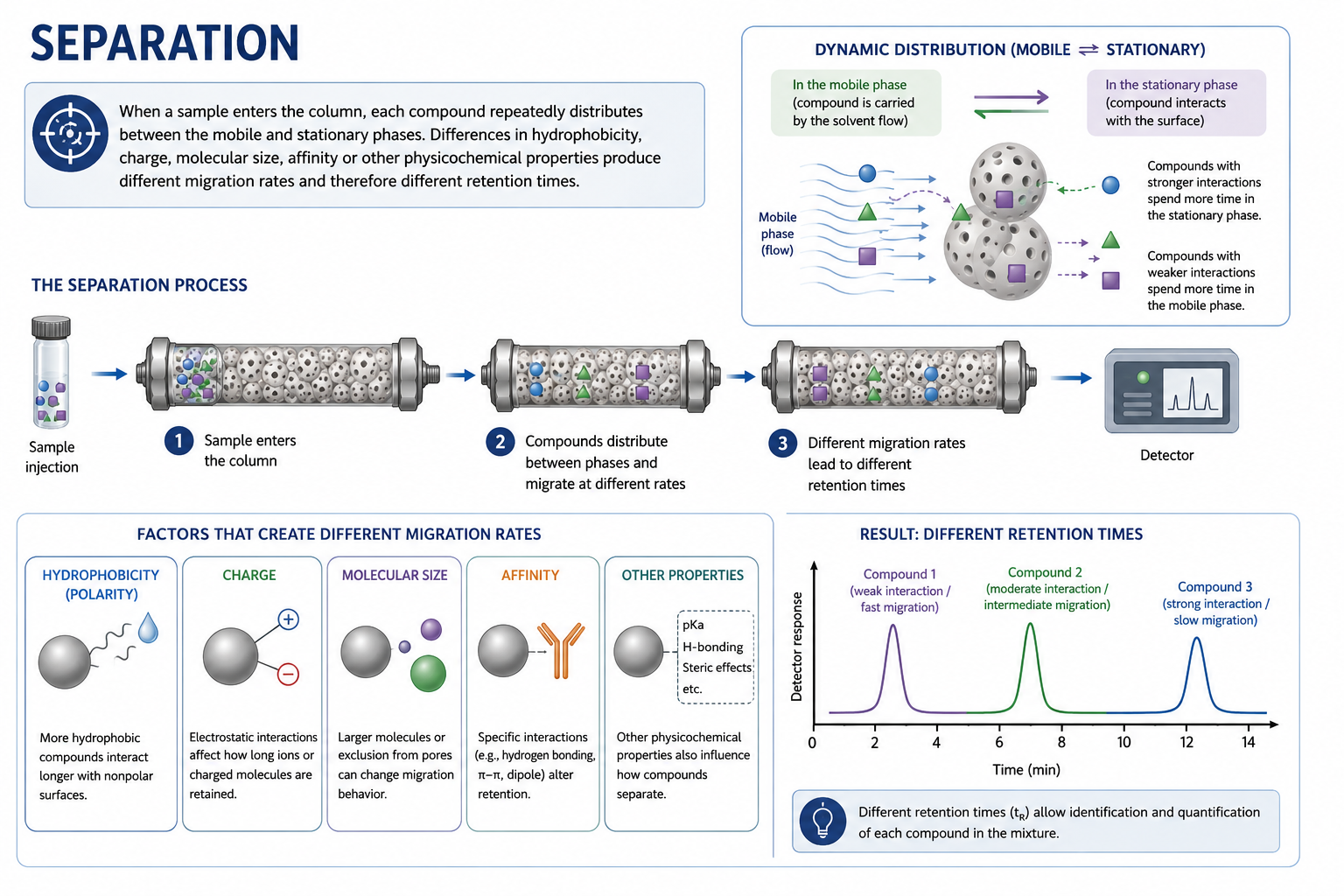
When a sample enters the column, each compound repeatedly distributes between the mobile and stationary phases. Differences in hydrophobicity, charge, molecular size, affinity or other physicochemical properties produce different migration rates and therefore different retention times.
What is an HPLC machine?
| HPLC component | Function |
|---|---|
| Solvent reservoir | Holds the mobile phase |
| Degasser | Removes dissolved gases that may create bubbles |
| Pump | Delivers the mobile phase at a controlled flow and pressure |
| Mixer | Combines solvents during gradient analysis |
| Injector or autosampler | Introduces a measured sample volume |
| Guard column | Helps protect the analytical column |
| Analytical column | Performs the chromatographic separation |
| Column oven | Controls column temperature |
| Detector | Measures compounds leaving the column |
| Data system | Records, integrates and processes chromatographic peaks |
What are the main types of HPLC?
Reversed-phase HPLC
Reversed-phase HPLC uses a relatively non-polar stationary phase and a more polar mobile phase. C18, C8 and phenyl phases are common examples.
It is frequently used for:
Pharmaceuticals
Small organic molecules
Peptides
Natural products
Metabolites
Retention is strongly influenced by hydrophobic interactions, mobile-phase composition and analyte ionization.

Normal-phase HPLC
Normal-phase chromatography uses a polar stationary phase with a less polar mobile phase. It may be useful for compounds whose separation depends on polarity, positional isomerism or specific surface interactions.

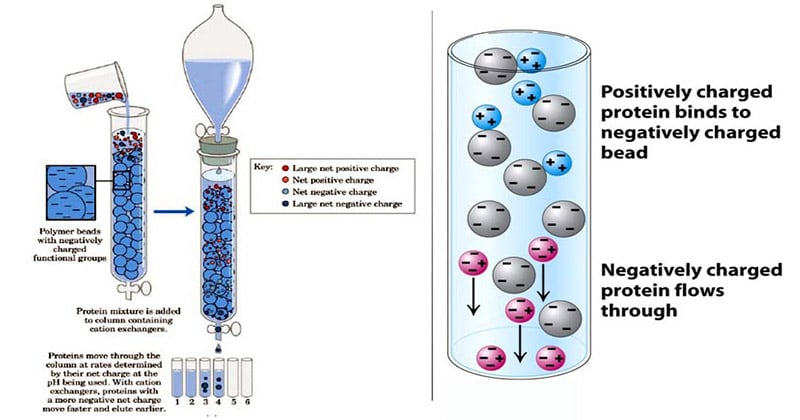
Ion-exchange chromatography
Ion-exchange HPLC separates compounds according to charge. It is applied to proteins, peptides, amino acids, nucleotides and other ionizable molecules.
Size-exclusion chromatography
Size-exclusion chromatography separates molecules primarily according to their effective size in solution. Larger molecules generally pass through the column more rapidly because they enter fewer pores in the stationary phase.

Affinity chromatography
Affinity chromatography uses a specific biological or chemical interaction between the analyte and an immobilized ligand.

Isocratic versus gradient HPLC
Isocratic elution
In an isocratic method, the mobile-phase composition remains constant during the analysis.
Advantages may include:
Simpler operation
Easier equilibration
Stable baselines
Straightforward transfer between instruments
It is often suitable when the analytes have similar retention behavior.
Gradient elution
In a gradient method, the mobile-phase composition changes over time.
A reversed-phase gradient may gradually increase the percentage of organic solvent, allowing weakly retained compounds to elute first and strongly retained compounds to elute later.
Gradient elution is particularly useful for samples containing compounds with a broad range of retention characteristics.

Frequently asked questions
What is HPLC chromatography?+
HPLC chromatography is a liquid-phase separation technique in which a pressurized mobile phase carries sample compounds through a column containing a stationary phase.
What is an HPLC machine?+
An HPLC machine is an analytical instrument containing a solvent-delivery system, injector, column, detector and data-processing software.
What is an HPLC test used for?+
An HPLC test may identify compounds, measure their concentration, evaluate purity, detect impurities, monitor degradation or characterize complex samples.
What is the mobile phase in HPLC?+
The mobile phase is the liquid solvent or solvent mixture that carries the sample through the HPLC column.
What is the stationary phase?+
The stationary phase is the material inside the column that interacts with sample compounds and produces separation.
What does an HPLC peak represent?+
An HPLC peak represents a detector response produced as a compound or group of unresolved compounds exits the column.
What does peak area mean?+
Peak area is the integrated detector response across a chromatographic peak. It is commonly used for quantification through comparison with standards.
Does one peak always represent one pure compound?+
No. Two or more compounds can co-elute and appear as one peak. Additional selectivity, spectral information or mass-spectrometric detection may be needed to confirm peak identity and purity.
When was HPLC invented?+
Modern HPLC emerged during the late 1960s through combined developments in small-particle columns, high-pressure pumping and sensitive detection. It is therefore more accurate to describe HPLC as the result of contributions from several researchers and technologies rather than the invention of one person.