Flow Cytometry Explained: Principles, Workflow, and Applications
Flow cytometry has become one of the most powerful analytical technologies in modern life science research. It enables scientists to rapidly analyze thousands of individual cells every second, providing valuable information about cell populations, protein expression, viability, proliferation, immune phenotypes, and much more. From immunology and cancer research to stem cell biology, microbiology, and biotechnology, flow cytometry has transformed the way researchers study complex biological systems. Combined with fluorescent antibodies, viability dyes, and sophisticated software, this technology delivers highly quantitative and reproducible results. At Gentaur, researchers can find a comprehensive portfolio of flow cytometry antibodies, fluorescent dyes, viability stains, buffers, sample preparation reagents, compensation controls, and laboratory consumables designed to support reliable flow cytometry experiments.
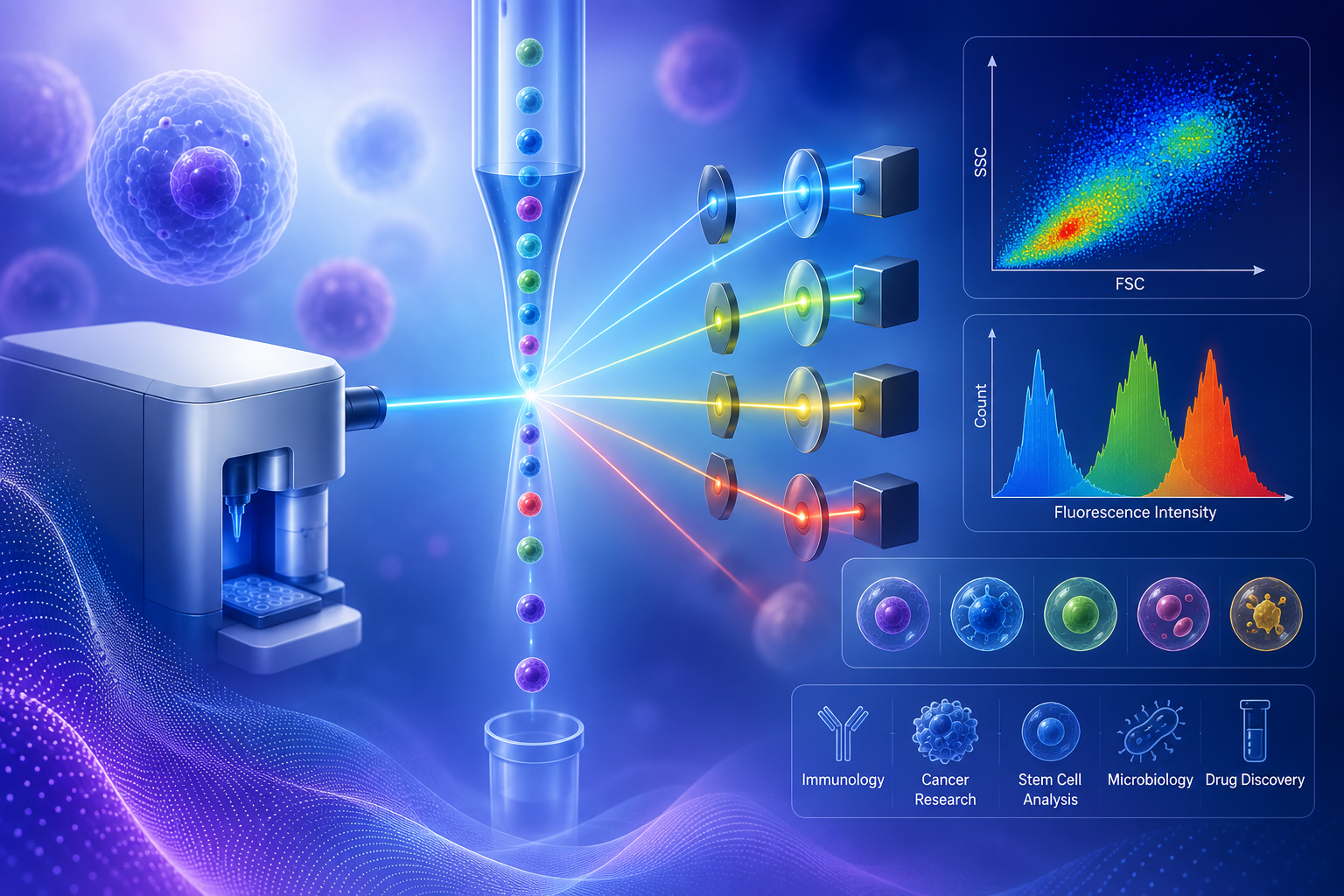
What is Flow Cytometry?

Why is Flow Cytometry Important?
Flow cytometry offers several advantages over traditional analytical methods.
Researchers benefit from:
High-throughput analysis
Multiparametric measurements
Single-cell resolution
Quantitative fluorescence detection
Excellent reproducibility
Rapid sample processing
Automated data acquisition
Simultaneous analysis of multiple biomarkers
These capabilities allow scientists to characterize complex biological samples with exceptional precision.
Related products
Hemocytometer
EVA Flow Cytometer
CytoFLUX FLOW CYTOMETER
LegendCyto Flow Cytometer
CytoFLUX FLOW CYTOMETER
LegendCyto Flow Cytometer
Flow Cytometry vs Fluorescence Microscopy
Feature | Flow Cytometry | Fluorescence Microscopy |
|---|---|---|
Speed | Very High | Moderate |
Single-cell analysis | Excellent | Excellent |
Quantification | Excellent | Moderate |
Throughput | Thousands/sec | Limited |
Population statistics | Excellent | Limited |
Multiparameter analysis | Excellent | Moderate |
Imaging capability | No | Yes |

Frequently asked questions
Is flow cytometry qualitative or quantitative?+
Flow cytometry provides quantitative measurements of fluorescence intensity, cell size, and granularity at the single-cell level.
How many cells can a flow cytometer analyze?+
Modern instruments commonly analyze 10,000–50,000 cells per minute, while advanced systems can process substantially higher event rates depending on the configuration.
What is the difference between FSC and SSC?+
Forward Scatter (FSC): correlates with cell size. Side Scatter (SSC): correlates with internal complexity or granularity.
Why are fluorescent antibodies used?+
Fluorescent antibodies specifically bind cellular proteins, enabling researchers to identify and quantify distinct cell populations.
Can flow cytometry analyze multiple markers simultaneously?+
Yes. Modern multicolor flow cytometry can detect numerous fluorescent markers in a single sample, depending on the instrument's lasers, detectors, and panel design.